
Iran's Red Sea Hedge:

Updated: Apr 23
Sudan, Sanctions, and the Geography of Strategic Insurance
By Suzan Quitaz
Iran's expanding footprint around the Red Sea is often read as an extension of its proxy strategy — opportunistic expansion into weak states and contested maritime corridors. That framing is not wrong, but it is incomplete. What is taking shape is something more structurally significant: a deliberate effort, driven by decades of sanctions pressure, to circumvent logistics corridors, and maritime access points. This is not mere power projection. It is economic adaptation by other means.
At the center of this architecture sits Sudan.
From Sanctions Pressure to Strategic Redundancy
Iran's external behavior has long been shaped by the persistence of Western sanctions and the volatility of its primary maritime outlet. During 2024, approximately 20 million barrels of oil per day moved through the Strait of Hormuz — roughly 27% of global maritime oil trade. That concentration of throughput is both Iran's greatest lever over global energy markets and its most exposed vulnerability in any sustained confrontation. Dependence on a single chokepoint creates structural fragility that no amount of military deterrence can fully resolve.
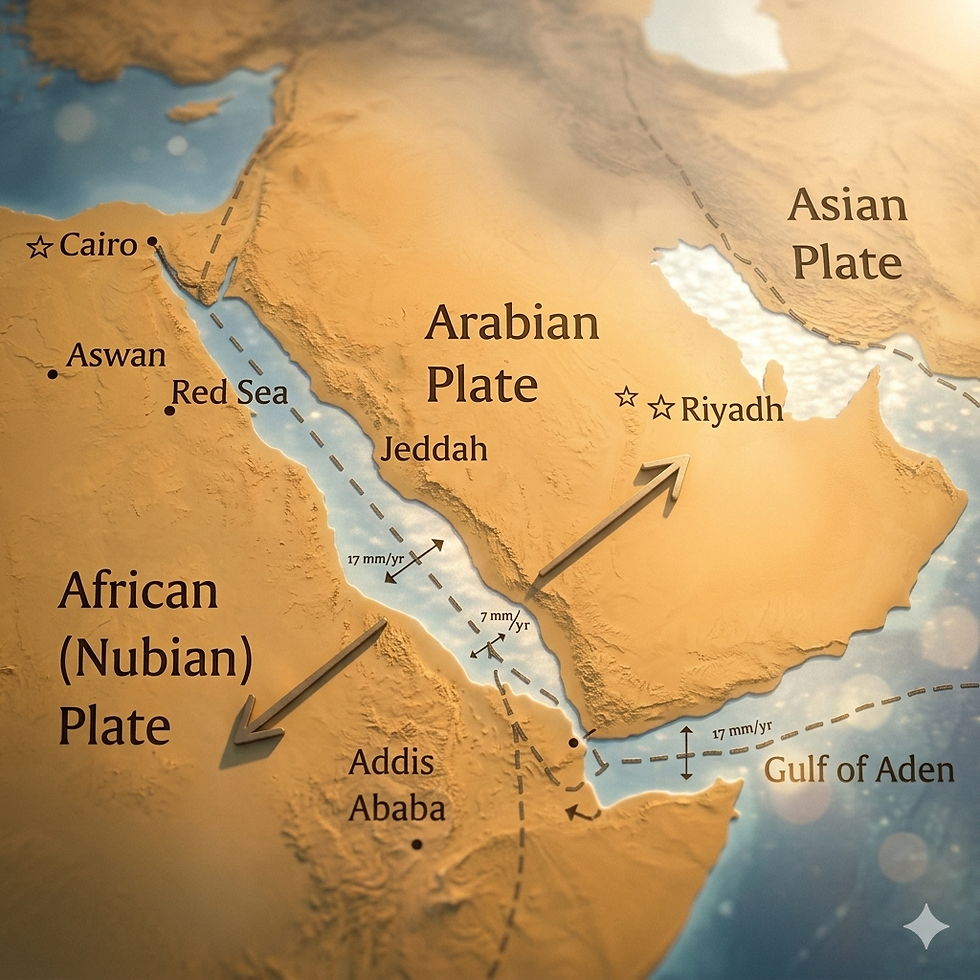
The Red Sea, therefore, offers something different: not a replacement for Hormuz, but a hedge against it. Through access points along the Red Sea littoral — particularly in states with weakened governance and receptive leaderships — Iran has been able to diversify the geography through which influence, materiel, and sanctioned goods can flow. Sudan, given its coastline and its proximity to both the Suez Canal and Bab el-Mandeb, occupies a uniquely valuable position within this logic.
What is emerging is a two-layer system: Hormuz as the primary pressure lever, the Red Sea as the secondary valve.
Sudan as Partner and Node
Iran's external behavior has long been shaped by the persistence of Western sanctions and the volatility of its primary maritime outlet. During 2024, approximately 20 million barrels of oil per day moved through the Strait of Hormuz — roughly 27% of global maritime oil trade. That concentration of throughput is both Iran's greatest lever over global energy markets and its most exposed vulnerability in any sustained confrontation. Dependence on a single chokepoint creates structural fragility that no amount of military deterrence can fully resolve.
The Red Sea, therefore, offers something different: not a replacement for Hormuz, but a hedge against it. Through access points along the Red Sea littoral — particularly in states with weakened governance and receptive leaderships — Iran has been able to diversify the geography through which influence, materiel, and sanctioned goods can flow. Sudan, given its coastline and its proximity to both the Suez Canal and Bab el-Mandeb, occupies a uniquely valuable position within this logic.
What is emerging is a two-layer system: Hormuz as the primary pressure lever, the Red Sea as the secondary valve.
Iran's relationship with Sudan is not merely transactional or narrowly military — it has genuine economic dimensions that have grown considerably since the two countries restored diplomatic relations in October 2023 after a seven-year rupture. Finance ministers from both countries have met to formalize expanded trade and economic cooperation, with Sudan's delegation highlighting the country's agricultural potential — oilseeds, sesame, peanuts, livestock — as well as its mineral resources as foundations for bilateral investment. More recently, Iran has signaled it will play an active role in Sudan's post-war reconstruction, with plans for ministerial committees and business forums to facilitate investment flows between the two countries.
Historically, the relationship has been deep, if inconsistent. Iran backed Omar al-Bashir's 1989 coup and provided development assistance and military aid to Sudan throughout the 1990s and 2000s, before Sudan cut ties in 2016 under pressure from Saudi Arabia and the UAE, which were offering substantial financial support in exchange for Khartoum's alignment against Tehran and its Houthi allies in Yemen.
The current rapprochement has accelerated sharply since the outbreak of Sudan's civil war. Between December 2023 and January 2024, Iran supplied Mohajer-6 reconnaissance and combat drones to the Sudanese Armed Forces, which proved effective in the SAF's offensive operations in Omdurman and areas west of Khartoum. This military support functions as a form of strategic barter — materiel exchanged for diplomatic alignment, economic access, and geographic positioning — but it sits alongside, rather than substituting for, the emerging economic relationship.
What makes Sudan particularly valuable is its geography. A Red Sea coastline facing one of the world's most sensitive maritime corridors is, in effect, strategic infrastructure. Iran's ultimate ambition is a direct naval presence in the Red Sea — a position that would give it the ability to threaten access to two critical global chokepoints simultaneously. Iran has already sought permission to station a permanent military vessel at Port Sudan, offering continued military aid as inducement — a request Sudan declined, citing concerns about backlash from Saudi Arabia, Egypt, and the West. That Sudan rejected the request does not diminish its strategic logic; it merely defers it. Analysts have noted that the SAF may soften its position as the war grinds on and its dependence on Iranian support deepens.
The Red Sea as a Sanctions-Adapted System
Iran's posture in the Red Sea cannot be understood in isolation from the broader network of actors operating along adjacent maritime corridors. The Houthi movement in Yemen is the most consequential of these. Since November 2023, Houthi forces have conducted over 190 attacks on Red Sea and Gulf of Aden shipping, forcing major carriers to reroute via the Cape of Good Hope and driving transit volumes through the Bab el-Mandeb down by nearly 57.5% at their nadir The economic consequences have been felt globally — freight rates surged, insurance premiums spiked, and supply chains built on just-in-time assumptions were disrupted across European and Asian markets.
For Iran, this creates a form of indirect leverage that does not require naval parity with the United States. What might be called systemic friction — a condition in which uncertainty itself becomes economically costly — serves Iranian interests without demanding direct engagement. The Houthis function as a distributed pressure mechanism, and Sudan, in this wider architecture, represents a potential extension point: a space where logistical, political, and military networks can be anchored closer to the corridor the Houthis have already helped destabilize.
Economic Logic Under Constraint
Iran’s strategy is not traditional economic expansion in this sense. Rather, it relies on building sanctions evasion networks, shadow shipping practices and building informal trading and financial systems. Within this logic, Sudan is not necessarily a market but a geographic asset to nurture. Its very location helps Iran control critical chokepoints and access routes that matter more than conventional trade flows.
What makes Iran's approach distinctive is that it does not resemble conventional economic expansion in any straightforward sense. Iran has spent years perfecting sanctions-evasion mechanisms — tanker-to-tanker transfers, document forgery, flag-of-convenience networks — that allow it to move petroleum and other goods through channels that operate outside formal financial oversight. The Sudan relationship fits within this broader architecture of constraint adaptation: not a replacement for the formal trade and investment Iran cannot easily access, but a complement to it.
Within that logic, control over geography — particularly chokepoints and coastal access — becomes more valuable than conventional market access. Sudan is not primarily interesting to Iran because of its consumer market or industrial base. It is interesting because of where it sits.
Implications for Regional Stability
The strategic significance of this model lies in its cumulative effect. No single relationship or corridor is decisive on its own. But together they constitute a distributed system of influence spanning the Gulf, the Horn of Africa, and the Red Sea basin — one that has proven surprisingly resilient to external pressure precisely because it does not depend on any single node.
Three implications follow. First, this model blurs the boundary between economic and military strategy. Trade corridors, logistics access, and proxy networks become functionally indistinguishable components of the same system. Second, it increases global shipping's sensitivity to localized instability — even limited conflicts in peripheral theaters can have disproportionate effects on freight pricing, route selection, and insurance markets far beyond the immediate zone of conflict. Third, it embeds external actors more deeply into internal conflicts. Sudan's war is not only a domestic struggle; it is a point of intersection for competing regional strategies, where external support is shaped as much by geography as by ideology.
Conclusion:
Iran's engagement with Sudan and the Red Sea is best understood not as expansion in the traditional sense, but as the construction of strategic insurance under conditions of sustained economic pressure. Sudan's value to Iran is defined by its position within a maritime system increasingly shaped by risk, fragmentation, and competition over chokepoints — but also, increasingly, by its potential as a genuine economic partner in reconstruction, trade, and investment as diplomatic ties deepen.
In that dual sense, the Red Sea is becoming part of a wider architecture of sanctions adaptation, one in which geography functions as a substitute for the financial and institutional access Iran cannot otherwise obtain. And in that architecture, Sudan is not peripheral. It is structurally essential.

Suzan Quitaz is a Kurdish-Swedish journalist and researcher specializing in Middle Eastern affairs. She previously worked as a field producer and journalist for several Qatari media outlets.


Comments